Drywall · 5 min read
Drywall patch or replace? What homeowners should know
Shorewise Home Services · September 30, 2026

Most drywall damage can be patched. Nail pops, dents, hairline cracks, doorknob holes and holes up to several inches across are all everyday repairs. Drywall needs to be cut out and replaced when it is soft, crumbling, sagging, stained from water, or growing mildew, or when the damaged area is large enough that a patch would be bigger than a new piece.
The hard part of drywall isn’t usually the patch. It’s making the wall look like nothing happened. Here’s how to tell which repair you need and what makes the difference between a patch you can see and one you can’t.
What kinds of drywall damage can be patched?
Nail pops and screw pops
These show up as small round bumps or circles in the paint, often in a line. They’re common in houses that go through big swings in temperature and humidity. The fix is to drive a new screw just beside the old fastener, set the old one below the surface, fill, sand and paint.
Dents, dings and small holes
Picture holes, anchor holes and dents from furniture fill with lightweight spackle. Two thin coats sanded smooth work better than one thick one.
Cracks
Hairline cracks at the corners of doors and closets, or along a seam, are usually cosmetic. They need to be opened up slightly, taped and filled. Filling them with spackle alone often lets them come back. If a crack keeps growing, gets wider at one end, or comes with doors that suddenly won’t close, have it looked at before patching.
Doorknob holes and holes up to several inches
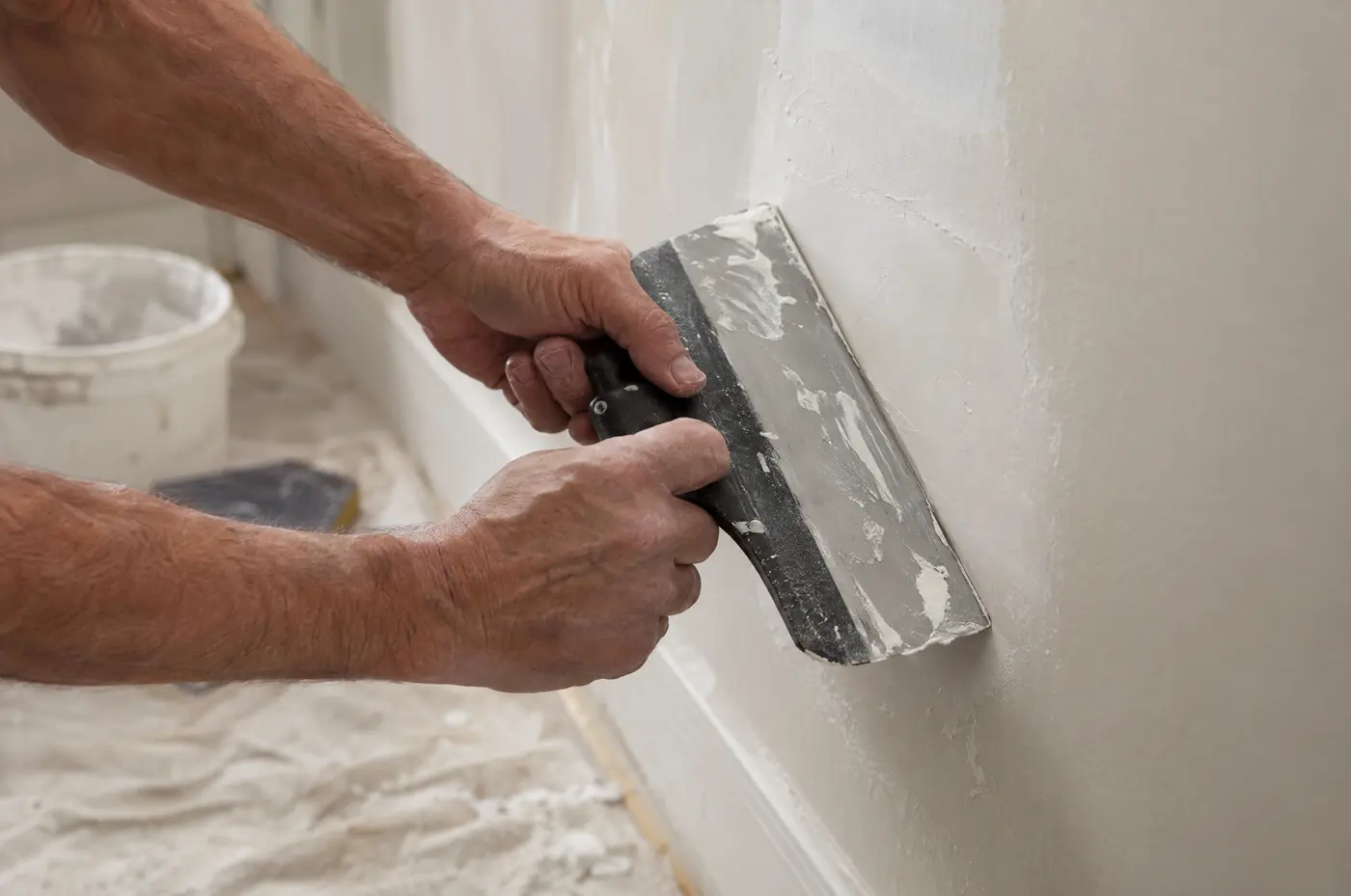
These need something behind or over the hole: a self-adhesive mesh patch for smaller holes, or a cut-to-fit drywall patch for larger ones. The patch is then covered with joint compound in several thin, wide coats.
Put a door stop in while you’re at it, or the same handle will make the same hole again.
When should drywall be replaced instead?
Replace the damaged section when:
- It has been wet and stayed wet. Drywall that sat damp can lose its strength and grow mildew on the paper facing, including on the side you can’t see.
- It feels soft or crumbles when you press on it.
- A ceiling is sagging between the framing.
- There’s a musty smell coming from that area, or visible dark spots.
- The damage is large, roughly more than a hand-width across, or covers several areas close together.
Replacing doesn’t usually mean a whole wall. The damaged area is cut back to a clean rectangle, ideally from the middle of one framing member to the next, and a new piece is fitted, taped and finished to blend with the rest.
One rule matters above the rest. If the damage came from water, the source has to be found and fixed first, by the right specialist. New drywall over a leak that hasn’t been fixed is money spent twice.
Why do some patches still show after painting?
Three reasons, most of the time.
The patch wasn’t feathered wide enough. Joint compound needs to taper out well beyond the repair, often several times its width, so there’s no ridge to catch the light.
The texture doesn’t match. Many Southwest Florida homes have a textured finish on walls and ceilings, like knockdown or orange peel. A perfectly smooth patch on a textured wall stands out as much as a lump would. Matching texture takes a little practice and a light hand.
Only the patch was painted. Fresh paint on an old wall rarely matches exactly, even when it’s the same color from the same can. The patch should be primed first so it doesn’t soak up paint differently, and then the whole wall painted from corner to corner.
A good test: look along the finished wall with a lamp or flashlight held off to one side. Raking light shows every ridge and dip.
Is drywall on exterior walls different?
In many Cape Coral homes, the outside walls are concrete block, with drywall fastened over thin strips of wood or metal on the inside. There’s less space behind it than on an interior wall. That matters if you are cutting in or hanging something heavy, and it’s another reason to know what is behind any wall before you cut into it.
Can I do it myself?
Small patches, yes. Spackle, a putty knife, a sanding sponge and patience go a long way. The larger repairs, ceiling work and texture matching take more practice to get invisible. A lot depends on whether you want it “good enough” or want nobody to ever notice.
If you’d rather have it done, Jimmy will give you a written price before any work starts. Most jobs start around $200. Get in touch.





Quick answers
In short.
Can I patch drywall that got wet?
If it dried quickly, is still firm and shows no staining or mildew, sometimes yes. If it feels soft, crumbles, sags or smells musty, cut it out and replace that section. Either way, fix the source of the water first.
Why can I still see my drywall patch after painting?
Usually because the patch wasn't feathered wide enough, the texture doesn't match, or only the patch was painted. Priming the patch and painting the whole wall, corner to corner, hides it far better.
How big a hole can be patched?
Small holes up to about the size of a coin fill with spackle. Larger ones up to several inches take a patch. Beyond that, it is usually neater to cut a clean square back to the framing and fit a new piece.